Rodriguez Earns Mexico’s First Medal at the 2016 Rio Games

2016 Rio Games

Misael Rodriguez has ended his country’s drought…

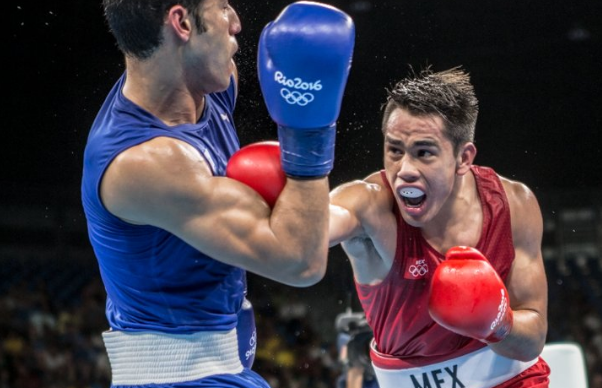
The Mexican boxer couldn’t counter strong counterattacks from Uzbekistan’s Bektemir Melikuziev, losing his bout in the semifinals of the Men’s Middle 75 kg competition at the 2016 Rio Games, so he had to settle for the bronze medal.

Misael Rodriguez

But there’s a silver lining…

Rodriguez earned the first medal for Mexico at the 2016 Summer Olympics, instantly becoming a national hero in Mexico.

Rodriguez began with power in the first assault, but he looked hurt by the Uzbek fighter. It appeared the cards were in Melikuzievs favor.

With a mission to finish his opponent, Rodriguez started the third chapter, under pressure to get the knockout, but his opponent’s experience proved to be too much. The fight ended in favor of the Melikuziev in a unanimous decision.

But earning any medal is meaningful to Rodriguez.

Less than a year ago, he was panhandling for spare change to gather funds to qualify for the Olympics.

Rodríguez had to beg not because Mexico is broke, but because of a power struggle between the federal agency that oversees sports, known as CONADE for its Spanish acronym, and the country’s various sporting federations.

The spat stems from an anti-corruption crusade started by CONADE’s director, former state prosecutor Alfredo Castillo, last year. Alleging irregularities, his agency cut funding to some of the sport federations. But the strategy hasn’t cleaned Mexico’s undeniably flawed sports system, commentators say. Instead, it’s resulting in one of Mexico’s most embarrassing Olympic performances in years.

But Rodriguez isn’t pointing fingers though, at least not publicly. News agency EFE quotes Rodríguez as saying, “Medals after begging taste sweeter.”

Pie Claims the Dominican Republic’s First Medal of the 2016 Rio Games

2016 Rio Games

Luisito Pie will return to his country a hero…

The 22-year-old Dominican taekwondo athlete defeated Spain’s Jesús Tortosa Cabrera in the Taekwondo Men’s 58 kg bronze medal match to claim his country’s first medal at the 2016 Rio Games.

Luisito Pie

Pie, who lost to eventual gold medalist Tawin Hanprab of Thailand in the semifinals, defeated his Spanish opponent by a score of 6-5.

With Pie’s medal, the Dominican Republic has picked up at least one medal in the last four Olympics.

Bednarczuk & Seixas Take Home the Silver in Women’s Beach Volleyball at the 2016 Rio Games

2016 Rio Games

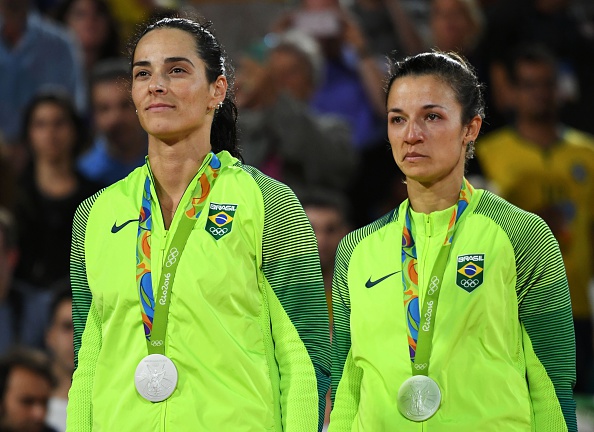
It was close, but no cigar for Agatha Bednarczuk and Barbara Seixas

The Brazilian beach volleyball players, the reigning FIVB Beach Volleyball world champions, lost to Germany’s Laura Ludwig and Kira Walkenhorst in the gold medal match on Copacabana Beach at the 2016 Rio Games.

Agatha Bednarczuk & Barbara Seixas

The 21-18, 21-14 victory gave Germany its first medal in women’s beach volleyball, just four years after the German men took the top spot on the Olympic podium at the 2012 London Games.

Bednarczuk and Seixas’ loss comes on the heels of their victory over April Ross and Kerri Walsh Jennings, who was gunning for her fourth straight Olympic gold in beach volleyball.

In that semifinal match, Bednarczuk and Seixas overcame a two-point deficit in the first set and scored points on two significant rallies in the second set to defeat the Americans.

Seeded second in the competition, Bednarczuk and Seixas had posted a 2-0 (22-20, 21-18) win in 48 minutes over the third-seeded Americans in the fifth international meeting between the two teams.  Ross and Walsh Jennings had won the previous two matches and led 3-1 heading into the Rio semifinal.

Ortega Wins Silver in the Men’s 110m Hurdles at the 2016 Rio Games

2016 Rio Games

Orlando Ortega is a silver bullet…

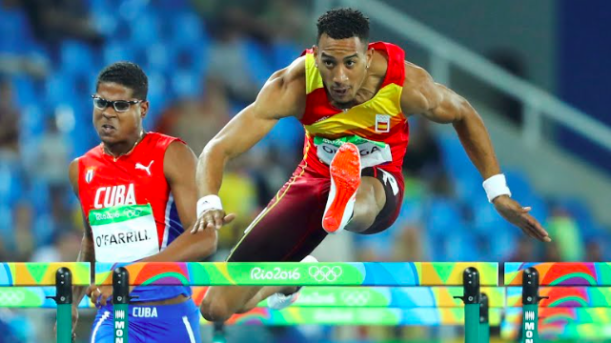
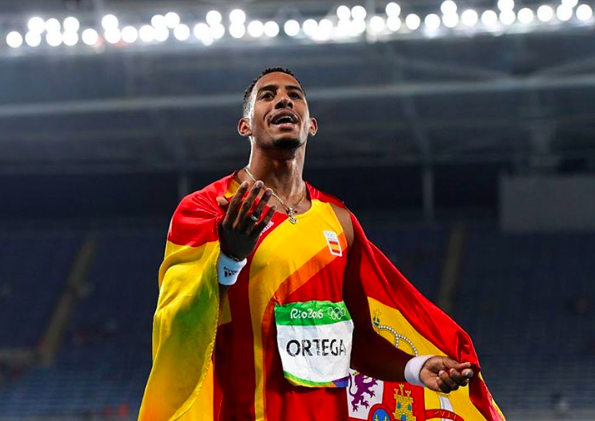
The 25-year-old Cuban-born Spanish track and field athlete claimed the silver medal in the men’s 110m hurdles at the 2016 Rio Games, giving Spain its first ever Olympic medal in the category.

Orlando Ortega

Ortega, a naturalized Spaniard, finished the race in a time of 13.17, .12 seconds shy of Jamaica’s Omar McLeod, who came into the race as the favorite.

France’s Dimitri Bascou took home the bronze with a time of 13.24.

Until he crossed the finish line, Ortega had no idea what position he occupied on the track. His had to overcome a rough start, but made up for it down the stretch.

Orlando Ortega

Ortega improved on his previous Olympic performance, when he finished sixth while representing his native Cuba at the 2012 London Games.

During the 2013 World Championships in Moscow, he defected from Cuba.

Caballero Wins Bronze in the Women’s Discus Throw at the 2016 Rio Games

2016 Rio Games

Denia Caballero has plenty of reason to throw a party…

The 26-year-old Cuban track and field athlete won the bronze medal in the women’s discus throw at the 2016 Rio Games, giving Cuba its fifth Olympic bronze medal.

Denia Caballero

Caballero, the reigning world champion in the sport, lost to Croatia’s Sandra Perkovic, the reigning Olympic champion, who took home the gold, and France’s Melina Robert-Michon, who won the silver.

Caballero’s best throw, her third release, registered at 65.34 meters, far from her best throw of the year of 67.62 meters. Perkovic’s best throw was at 69.21 meters, Robert-Michon best was at 66.73 meters.

In collecting the bronze, Caballero, who surprisingly beat Perkovic to gold at last year’s world championships, secured her country’s third successive medal in the event.

“I wanted a gold medal but I will take any color. It will not be my last Olympics,” vowed the Cuban.

Conceição Wins Brazil’s First Gold Medal in Boxing at the 2016 Rio Games

2016 Rio Games

Robson Conceição is officially Brazil’s first boxing Golden boy….

The 27-year-old Brazilian amateur boxer won Brazil’s first Olympic boxing gold medal on Tuesday night at the 2016 Rio Games, delighting a frenzied home audience with a unanimous decision over France’s Sofiane Oumiha.

Robson Conceição

But Conceição couldn’t step up onto a medal podium without thinking about where his journey began.

His mind is never far from his impoverished neighborhood, where he discovered and honed a boxing talent that finally lifted him all the way into Brazilian sports history.

“It’s amazing that my life has changed forever,” Conceição said.

The largest boxing crowd of the Olympics filled the arena with songs, cheers and foot-stomping craziness for Conceição, who found his path out of poverty through the boxing rings of the state of Bahia, the sport’s biggest hotbed in Brazil.

Robson Conceição

“It was an incredible feeling to represent the whole of Brazil and also Bahia,” said Conceição, who stood atop the podium with his arms raised, basking in cheers.

“I continued to fight because of them. They gave me the strength when I was fighting, so it was an incredible feeling. It’s because of them that I got this medal.”

Conceição is an appropriate trailblazer in a sport without a rabid passion or fan base in Brazil. Conceição fights aggressively, but with a Cuban-style skill base and an elusive fluidity that contains hints of capoeira, samba and the clever style of Anderson Silva, Brazil’s greatest mixed martial artist.

Even if they don’t follow boxing, everybody in Brazil recognizes something in his style, Conceição suggested earlier in the tournament. And now they’ll all understand the gold around his neck.

Conceição, a three-time Olympian, reached the peak of his skills just in time for his home games, storming through his bracket as the third seed and winning gold.

He credits his abilities to Bahia, where athletic Cuban fighting styles are often taught by imported Cuban coaches.

“Bahia has got the strongest reputation for boxing in the whole of Brazil,” he said. “That’s only because there’s a lot of poverty. A lot of kids are encouraged to box to get out, to escape.”

Brazil had won one silver and three bronze boxing medals in its modest Olympic boxing history, but Conceição proved he deserved his gold with a strong performance against Oumiha.

Conceição’s elusiveness, aggressiveness and creative punching kept Oumiha frustrated and hurt for the first two rounds, and a solid third was too late for the Frenchman.

Conceição collapsed to his knees when the decision was announced. He then jumped against the turnbuckle and onto the ropes, waving his adoration at the singing, roaring crowd. He eventually climbed out of the ring to kiss his young daughter, Sofia, and his wife, Erika Mattos, who is also a boxer.

Conceição claimed Brazil’s third gold medal of its home games, joining men’s pole vault champion Thiago Braz da Silva and women’s judo lightweight Rafaela Silva.

Unlike most of his Brazilian boxing teammates, Conceição is a tested veteran and a serious contender for the top honors in their sport. Along with his Olympic experience at the 2008 Beijing Games and the 2012 London Games, he finished second at the 2013 world championships and third in 2015.

After receiving an opening bye, Conceição advanced to the gold-medal match with a quarterfinal win over Uzbekistan’s Hurshid Tojibaev and a cathartic semifinal victory over Cuba’s Lazaro Alvarez, a three-time world champion and two-time Olympic bronze medalist.

Queiroz Gives Brazil Its First-Ever Canoeing Medal at the 2016 Rio Games

2016 Rio Games

It’s a special first for Isaquias Queiroz

The 22-year-old Brazilian sprint canoeist has earned his country its first-ever Olympic medal in canoeing.

Screen Shot 2016-08-17 at 11.08.47 AM

But Queiroz didn’t just have to train hard to earn that medal at the 2016 Rio Games — he had to survive.

Queiroz, who narrowly lost to Germany’s Sebastian Brendel to win silver in the men’s single 1000-meter canoe race, escaped death three times before he turned 11. At age 3, a pot of boiling water fell on him scalding large sections of his body. Doctors told his mother to prepare for his death, according to Brazil’s O Globo newspaper, but she refused to believe the prognosis, and she was correct.

While Queiroz’s body healed, life still became tougher for him. At age 5, Queiroz, who grew up in poverty-stricken northeastern Brazil, was kidnapped. His father also died that year. Queiroz was eventually returned to his mother unharmed, but tragedy would strike again five years later.

At age 10, Queiroz fell out of a tree and onto a rock while trying to get a better look at a snake hanging from a branch. After being transferred to a larger town’s hospital, doctors found his kidney had nearly split in two. They eventually removed the kidney.

That last hardship stayed with Queiroz for life, not only in the form of a scar, but in the nickname “Sem Rim,” which means “Missing Kidney.”

While doctors warned Queiroz to stay away from sports, the resilient kid had other plans.

“I never thought if I would have a complicated life because of that,” Queiroz tells SB Nation on Monday. “As soon as I could, I came back and had a normal life.”

“Normal” is probably an understatement. With his win Tuesday, Queiroz is becoming a superstar in his homeland, and especially in his hometown of Ubaitaba, where he seized an opportunity at age 11 to get involved in canoeing thanks to a government-funded project.

“From his first contact with the water, I realized that he was good, that he had something special,” Queiroz’s childhood coach, Figueroa Conceicao, told the Associated Press this week.

Queiroz quickly rose through the ranks in the canoeing world. At age 17, he became a junior world champion. At age 19, he won his first world title. He’s since won two more.

Isaquias Queiroz

Now, at 22, he’s reached the pinnacle of his sport — the Olympics.

“My race was very good,” he said Tuesday (via O Globo). “I lost a little there at the end, but getting the silver medal at my first Olympics is very good.”

Queiroz’s Olympic quest isn’t over either. He’ll go for more medals — he’s still hoping for a gold — Wednesday when he competes for a spot in the men’s canoe single 200-meter sprint, and Friday, he’ll pair up with Brazil’s Erlon Silva for the men’s canoe double 1,000-meter race.

“I feel emotional to represent my country in Rio,” Queiroz told SB Nation. “It’s a dream come true for any athlete, especially for me since it’s my first Olympic Games with the chance of winning three medals in my home country.”

Leyva Wins Two Silver Medals in Men’s Gymnastics at the 2016 Rio Games

2016 Rio Games

Danell Leyva has redeemed himself in a big way…

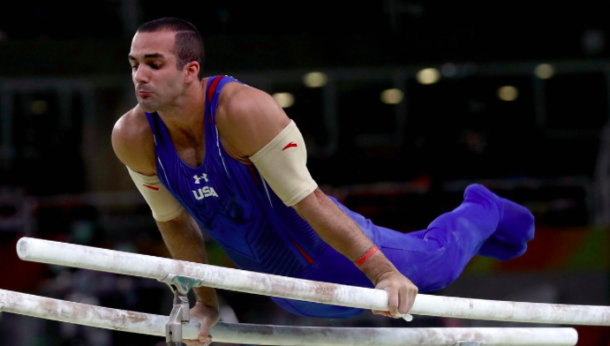
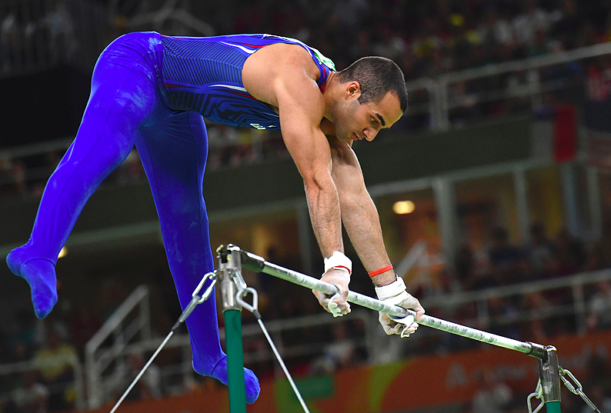
The 24-year-old Cuban American gymnast earned two silver medals in the final day of gymnastics competition on Tuesday at the 2016 Rio Games.

Danell Leyva

Leyva, who was a late replacement to the US Men’s Gymnastics team when an injured John Orozco had to bow out, claimed silver on both parallel bars and high bar, completing a three-month journey from injury to alternate to medalist.

“Nobody has a perfect day, but I feel like this was this as close to perfect as I possibly could have gotten,” Leyva said, “and I’m incredibly happy.”

Oleg Verniaiev won gold in the men’s parallel bars event Tuesday with a score of 16.041, edging  Leyva , and David Belyavskiy of Russia, who won bronze.

Danell Leyva

Leyva won a second silver medal on the horizontal bar, finishing behind Fabian Hambuechen of Germany, who won gold, and ahead of Nile Wilson of Britain, who won bronze.

Leyva began his afternoon’s work with the parallel bars and completed it with the horizontal bar, from which he had fallen during last week’s men’s team final.

“This was absolutely a redemption, not only for me but for the team as well. My success is as much for the team as it is for me,” he said.

It was a bit of a shock when Leyva wasn’t selected to compete at the 2016 Summer Olympics. Leyva, who took home a bronze medal four years ago at the 2012 London Games, was chosen to serve as a team alternate. Leyva was the only U.S. male gymnast to bring home a medal in 2012.


Well, he got his redemption on Tuesday in Rio, earning his pair of silver medals.

López Defeats Rival Riza Kayaalp to Claim Third Straight Greco-Roman Gold Medal at the 2016 Rio Games

2016 Rio Games

It’s a three-peat for Mijaín López

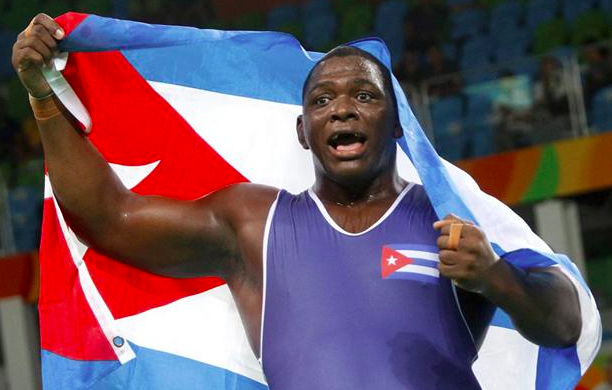
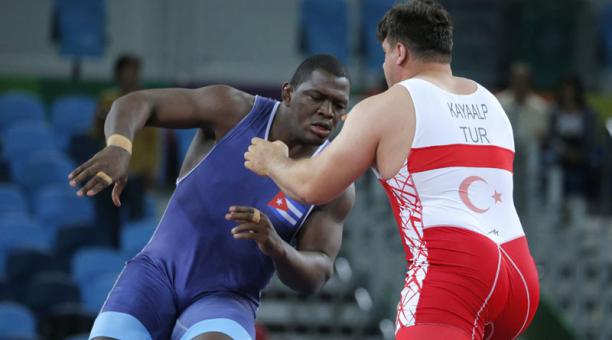
The 33-year-old Cuban wrestler, widely regarded as one of the greatest wrestlers of all time, won his third consecutive Olympic title in Greco-Roman’s heaviest weight class after defeating longtime rival Riza Kayaalp of Turkey in the 130kg Gold Medal match at the 2012 Rio Games.

Mijaín López

It marked the third straight year that Lopez and Kayaalp met in the final round with a major global title on the line. They also faced each other in the Gold Medal matches at the world championships the last two years — Lopez won in 2014, Kayaalp won in 2015.

Their rivalry also includes a bout in the semifinals of the 2012 London Games, which was won by Lopez. He would go on to win the gold medal after defeating Estonia’s Heiki Nabi.

Mijaín López

Lopez got the scoring started early this time around, hitting a big four-point throw about 15 seconds into the match. The bout got chippy late, with Kayaalp connecting with Lopez’s head after the whistle blew. Kayaalp’s move briefly awarded two penalty points to Lopez, which would have given him an 8-0 victory by technical superiority, but the points were taken off the board. The match resumed with less than a minute to go, and Lopez ultimately emerged with a 6-0 win.

Lopez also won the gold medal at the 2008 Beijing Games.

Braz Dethrones Reigning Champion in Men’s Pole Vault at the 2016 Rio Games

2016 Rio Games

Thiago Braz has dethroned the reigning Olympic champion in record fashion…

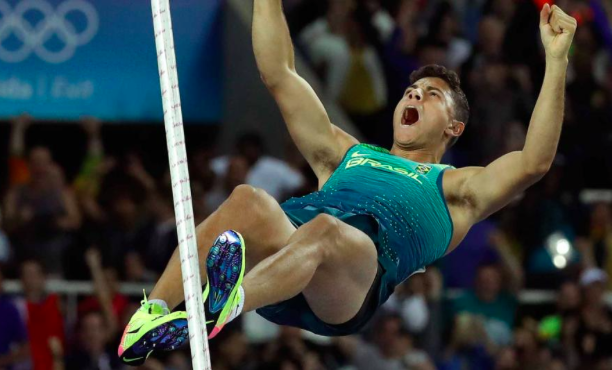
The 22-year-old Brazilian track & field athlete set an Olympic record of 6.03m to win the gold medal in the men’s pole vault at the 2016 Rio Games.

Thiago Braz da Silva

Defending champion Renaud Lavillenie of France looked on course to retain his title after clearing a height of 5.98m.

Braz, who passed at 5.98m, failed his first attempt at 6.03m but went clear with his second to win the hosts’ second gold medal of the Games.

Lauvillenie took silver, while American Sam Kendricks claimed the bronze with 5.85m.

“The crowd were cheering me too much. I had to fix my mind on my technique, forget the people,” Braz said.

“The gold? Incredible. My first time over six meters. My hometown wanted me to win.”

The pole vault competition was delayed because of rain and then held up with a mechanical fault that temporarily saw the bar unable to be raised, but ended in a thrilling conclusion that finished just before midnight local time.

Braz added 11 centimeters to his previous personal best to set a national record and become only the fourth Brazilian to win a track and field gold at an Olympics.

The last Brazilian Olympic gold medallist in an athletics event was Maurren Maggi, who won the women’s long jump at 2008 Beijing Games.