Bad Bunny is celebrating a special first…
The 31-year-old Puerto Rican superstar was the big winner at Thursday night’s Latin Grammy Awards in Las Vegas, taking home five trophies, including album of the year for his acclaimed Debí Tirar Más Fotos, a project which embraced his island’s musical heritage – and paved the way for him to be named the performer for next year’s Super Bowl halftime show.
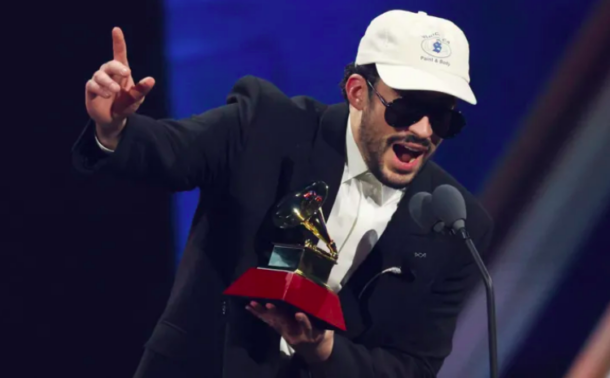 It’s Bad Bunny’s first-ever win in the album of the year category.
Dedicating the award to “all the youth of Latin America” he added: “There are many ways of being patriotic and defending our homelands. We chose music.”
Argentinian duo Ca7riel and Paco Amoroso also claimed five awards; with other winners including Alejandro Sanz, Gloria Estefan and Karol G.
The rapidly growing Latin music sector generated a record $1.4bn (£1.06bn) in 2024, making up 8.1% of total U.S. music revenue, according to the Recording Industry Association of America (RIAA), which said it was shaping culture faster than any other genre.
Bad Bunny, real name Benito Antonio Martínez Ocasio, has been at the forefront of that movement. For three consecutive years between 2020 and 2022, he was the most-streamed artist in the world.
Debí Tirar Más Fotos is his sixth album, and fuses live instrumentation with the hip-swaying pulse of reggaetón and traditional Puerto Rican styles like plena.
At the Latin Grammys, the title track earned him best urban song and best urban performance. He also picked up best reggaetón performance for “Voy a llevarte pa PR,” and best urban music album for Debí Tirar Más Fotos.
He’s nominated for six awards at the mainstream Grammys, which take place in February, including the three major categories of album, song and record of the year.
Bad Bunny recently wrapped up a barnstorming concert residency in Puerto Rico; and is about to kick off his world tour in the Dominican Republic.
However, he made headlines when he said the tour would not include any dates on the US mainland because he was concerned his fans might be targeted by immigration raids.
His subsequent booking for next year’s Super Bowl rankled some US conservatives.
President Donald Trump called the decision “absolutely ridiculous” and that he had “never heard” of the star – who has 74 million monthly listeners on Spotify.
The Latin Grammy ceremony kicked off with a star-studded tribute to Mexican-American guitarist Carlos Santana, with Maluma, Edgar Barrera, Grupo Frontera and Christian Nodal playing a medley that began with his hit single “Oye Como Va.”
Karol G and Marco Antonio Solís also took the stage for a sweet duet on “Coleccionando Heridas;” while Gloria Estefan played songs from her latest record Raíces, which went on to win best tropical album.
But Ca7riel and Paco Amoroso were judged to have the stand-out moment of the evening, with a colourful, off-the-wall medley of their hits “El Impostor,” “#Tetas,” “La Que Puede,” “Puede” and “El Día Del Amigo.”
The duo dominated the alternative music categories – winning best alternative album and best alternative song. They also picked up best short-form and best long-form video, and pop song of the year for “El Día Del Amigo.”
Speaking backstage, the childhood friends expressed their gratitude to each other.
“The most important thing here is that we’ve known each other since we were six years old,” said Amoroso.
“All of this wasn’t planned, it just happened. I want to tell Ca7riel that he’s my friend, that I love him.”
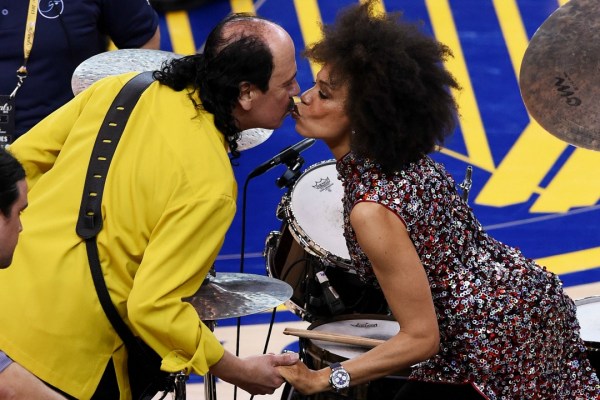
Ca7riel then surprised Paco with a long and seemingly passionate kiss.
Elsewhere, Paloma Morphy, a 25-year-old Mexican singer, won best new artist after her debut album, Au, seduced listeners with its catchy melodies and vulnerable stories of heartbreak.
Karol G won song of the year for “Si Antes Te Hubiera Conocido,” a lilting love song with a Merengue flavor, from her blockbuster fifth album Tropicoqueta.
And Spanish superstar Alejandro Sanz picked up record of the year for his beautiful ballad “Palmeras en el Jardín” – unexpectedly beating Bad Bunny’s smash hit “Baile Inolvidable.”
Here are the winners of the 26th Latin Grammy Awards:
Record Of The Year
Palmeras En El Jardín — Alejandro Sanz
Album Of The Year
Debí Tirar Más Fotos – Bad Bunny
Song Of The Year
‘Si Antes Te Hubiera Conocido’
Edgar Barrera, Andres Jael Correa Rios & Karol G, songwriters (Karol G)
Best New Artist
Paloma Morphy
Best Contemporary Pop Album
¿Y Ahora Qué? — Alejandro Sanz
Best Traditional Pop Album
Bogotá — Andrés Cepeda
Best Pop Song
‘El Día Del Amigo’
Papota — Rafa Arcaute, Gino Borri, CA7RIEL, Ulises Guerriero,
Amanda Ibanez, Vicente Jiménez & Federico Vindver,
songwriters (CA7RIEL & Paco Amoroso)
Best Latin Electronic Music Performance
‘Veneka’
Rawayana Featuring Akapellah
Best Urban/Urban Fusion Performance
‘Dtmf’
Debí Tirar Más Fotos — Bad Bunny
Best Reggaeton Performance
‘Voy A Llevarte Pa Pr’
Debí Tirar Más Fotos — Bad Bunny
Best Urban Music Album
Debí Tirar Más Fotos — Bad Bunny
Best Rap/Hip Hop Song
‘Fresh’
Trueno, songwriter (Trueno)
Best Urban Song
‘DtMF’
Debí Tirar Más Fotos — Bad Bunny, Marco Daniel Borrero, Scott Dittrich,
Benjamin Falik, Roberto Jose Rosado Torres, Hugo Rene
Sencion Sanabria & Tyler Spry, songwriters (Bad Bunny)
Best Rock Album
Novela — Fito Paez
Best Rock Song (TIE)
‘La Torre’
R — RENEE, songwriter (RENEE)
&
‘Sale El Sol’
Novela — Fito Paez, songwriter (Fito Paez)
Best Pop/Rock Album
Ya Es Mañana — Morat
Best Pop/Rock Song
‘Desastres Fabulosos’
Conociendo Rusia, Jorge Drexler & Pablo Drexler,
songwriters (Jorge Drexler & Conociendo Rusia)
Best Alternative Music Album
Papota — CA7RIEL & Paco Amoroso
Best Alternative Song
‘#Tetas’
Paco Amoroso, Rafa Arcaute, Gino Borri, CA7RIEL,
Gale, Vicente Jiménez ‘Vibarco’ & Federico Vindver,
songwriters (CA7RIEL & Paco Amoroso)
Best Salsa Album
Fotografías — Rubén Blades y Roberto Delgado & Orquesta
Best Cumbia/Vallenato Album
El Último Baile — Silvestre Dangond & Juancho De La Espriella
Best Merengue/Bachata Album
Novato Apostador — Eddy Herrera
Best Traditional Tropical Album
Raíces — Gloria Estefan
Best Contemporary Tropical Album
Puñito De Yocahú — Vicente García
Best Tropical Song
‘Si Antes Te Hubiera Conocido’
Edgar Barrera, Andres Jael Correa Rios & Karol G,
songwriters (Karol G)
Best Singer-Songwriter Album
Cancionera — Natalia Lafourcade
Best Singer-Songwriter Song
‘Cancionera’
Natalia Lafourcade, songwriter (Natalia Lafourcade)
Best Ranchero/Mariachi Album
¿Quién + Como Yo? — Christian Nodal
Best Banda Album
4218 — Julión Álvarez y su Norteño Banda
Best Tejano Album
Bobby Pulido & Friends Una Tuya y Una Mía (Vol.1/En Vivo) — Bobby Pulido
Best Norteño Album
La Lotería — Los Tigres Del Norte
Best Contemporary Mexican Music Album
Palabra De To’s (Seca) — Carín León
Best Regional Song
‘La Lotería’
Luciano Luna, songwriter (Los Tigres Del Norte)
Best Instrumental Album
Y El Canto De Todas — Rafael Serrallet Featuring Lviv Philharmonic
Orchestra
Best Folk Album
Joropango — Kerreke, Daniela Padrón
Best Tango Album
En Vivo 20 Años — Tanghetto
Best Flamenco Album
Flamencas — Las Migas
Best Roots Song
‘Aguacero’
Luis Enrique Mejia, Fernando Osorio & Rodner Padilla,
songwriters (Luis Enrique, C4 Trío)
Best Latin Jazz/Jazz Album (TIE)
Hamilton De Holanda Trio – Live In NYC — Hamilton De Holanda
&
Cuba & Beyond — Chucho Valdés & Royal Quartet
Best Christian Album (Spanish Language)
Legado — Marcos Witt
Best Portuguese Language Christian Album
Memóri4s (Ao Vivo) — Eli Soares
Best Portuguese Language Contemporary Pop Album
Caju — Liniker
Best Portuguese Language Rock or Alternative Album
O Mundo Dá Voltas — Baianasystem
Best Portuguese Language Urban Performance
‘Caju’
Caju — Liniker
Best Samba/Pagode Album
Sorriso Eu Gosto No Pagode Vol.3 – Homenagem Ao Fundo De Quintal (Gravado Em Londres) — Sorriso Maroto
Best MPB (Musica Popular Brasileira)/MAPB (Música Afro Portuguesa Brasileira) Album
Um Mar Pra Cada Um — Luedji Luna
Best Sertaneja Music Album
José & Durval — Chitãozinho & Xororó
Best Portuguese Language Roots Album
Dominguinho — João Gomes, Mestrinho e Jota.pê
Best Portuguese Language Song
‘Veludo Marrom’
Caju — Liniker, songwriter (Liniker)
Best Children’s Album
Los Nuevos Canticuentos — Canticuentos, Coro de Ríogrande
Best Classical Album
Kaleidoscope – Contemporary Piano Music By Female Composers From Around The World — Isabel Dobarro; Javier Monteverde, album producer
Best Classical Contemporary Composition
‘Revolución Diamantina – Act I: The Sounds Cats Make,
Act II: We Don’t Love Each Other, Act III: Borders And
Bodies, Act IV: Speaking The Unspeakable’
Gabriela Ortiz: Revolución Diamantina — Gabriela Ortiz, composer (Gustavo Dudamel, Los
Angeles Philharmonic & Los Angeles Master Chorale)
Best Music For Visual Media
Cien Años De Soledad (Banda Sonora De La Serie De Netflix) — Camilo Sanabria (Camilo Sanabria, artist); Camilo Sanabria, composer
Best Arrangement
‘Camaleón’
Cesar Orozco, arranger (Cesar Orozco & Son Ahead)
Best Recording Package
‘Cuarto Azul’
Christian Molina, art director (Aitana)
Songwriter of the Year
Edgar Barrera
‘Atención’ – Ivan Cornejo
‘Contigo Al Cielo’ – Christian Nodal
‘Ese Vato No Te Queda’ – Carin León Featuring Gabito Ballesteros
‘Hoy No Me Siento Bien’ – Alejandro Sanz & Grupo Frontera
‘Milagros’ – Karol G
‘Si Antes Te Hubiera Conocido’ – Karol G
‘Soltera’ – Shakira
‘Tommy & Pamela’ – Peso Pluma, Kenia Os
‘Una Noche Contigo’ – Juanes
Best Engineered Album
Cancionera — Jack Lahana, engineer; Jack Lahana, mixer; Bernie
Grundman, mastering engineer (Natalia Lafourcade)
Producer of the Year (TIE)
Rafa Arcaute, Federico Vindver
‘El Día Del Amigo’ – CA7RIEL & Paco Amoroso
‘Impostor’ – CA7RIEL & Paco Amoroso
‘La Noche De Tu Amor’ – ATGGT, Victoria May
‘Los Ejes De Mi Carreta’ – ATGGT, Victoria May
‘Re Forro’ – CA7RIEL & Paco Amoroso
‘#Tetas’ — CA7RIEL & Paco Amoroso
&
Nico Cotton
‘Agridulce’ – Bhavi, Duki
‘Carne Viva’ – Blair, Dillom
‘Cuarto Azul’ – Aitana
‘Desastres Fabulosos’ – Jorge Drexler, Conociendo Rusia
‘Latinaje’ – Cazzu
‘Museo Del Prado’ – Manuel Carrasco
‘Perfecto Final’ – Conociendo Rusia, Nathy Peluso
‘Una Noche Contigo’ – Juanes
‘Ya Es Mañana’ – Morat
Best Short Form Music Video
‘#Tetas’
CA7RIEL & Paco Amoroso
Martin Piroyansky, video director; Pío Filgueira Risso &
Lula Meliche, video producers
Best Long Form Music Video
Papota (Short Film)
CA7RIEL & Paco Amoroso
Martin Piroyansky, video director; Federico Ameglio,
Chino Fernández & Lula Meliche, video producers